


BRSR and the Boardroom: What Corporate Cafeteria Management Has to Do with Your ESG Score
- Paroma Bhattacharyya

- 4 days ago
- 6 min read

Remember the times your team discussed corporate cafeteria management during board meetings? Rarely, right? That's because it runs quietly in the background in the form of food partners (vendors) renewed, rotating menus, feedback forms read and filed away, the same process on repeat unless something gets flagged.
That's starting to change. A slice of that everyday operation is now feeding, almost without anyone planning it that way, into one of India's most closely watched compliance documents: the Business Responsibility and Sustainability Report (BRSR).
But What is BRSR?
The Business Responsibility and Sustainability Report (BRSR) is a SEBI-mandated ESG disclosure framework that requires India's top 1,000 listed companies to report standardized, quantitative data on their environmental, social, and governance performance. It is replacing the older, more narrative Business Responsibility Report.
Introduced in 2021 and mandatory from FY 2022-23, it structures disclosures into three parts: general company information, management and process disclosures on responsible business conduct, and principle-wise performance data covering areas like emissions, water, waste, and workforce practices.
A Compliance Framework That's Grown Teeth

BRSR itself isn't new. SEBI made it mandatory for India's top 1,000 listed companies from FY 2022-23, replacing the older, largely narrative Business Responsibility Report. What is new is how seriously it's being enforced.
In 2023, SEBI introduced BRSR Core, a tighter set of roughly 30 KPIs that require independent, audit-grade assurance rather than a company simply describing its own intentions. That assurance requirement currently covers India's 150 largest listed companies and is on a glide path to reach all 1,000 by FY 2026-27. The days of writing a good sustainability story at year-end are closing.
The stakes are real, not theoretical. SEBI can initiate adjudication under Section 15HB of the SEBI Act, with penalties running up to INR 1 crore for non-compliance, and a poor filing doesn't stay quiet. It becomes part of the ESG ratings that CRISIL, ICRA, and S&P Global assign, which in turn shapes how foreign investors and capital markets read a company's risk profile.
Where the Cafeteria Fits into a Sustainability Filing
This is where it touches the cafeteria. Among BRSR's essential indicators is a requirement to report waste generated by type, alongside energy, water, and emissions data. Food waste doesn't get its own dedicated line item, but it doesn't disappear either. It sits inside the broader waste and resource-efficiency figures a company now has to measure, disclose, and eventually get assured.
A number that used to live quietly in a facilities report is now, indirectly, part of the sustainability document the board reviews.
CHROs, HR teams, and facility leaders already run enormous, people-first operations - hiring, retention, real estate, wellness, and yes, feeding thousands of people a day, often across multiple campuses. The cafeteria was never a source of worry and has been perceived as "managed perfectly well". What's changed now is that a part of this very operation, which ran so capably, now carries a trail that reaches further than it used to.
The Scale of the Problem, in Numbers

The scale is worth sitting on. The UNEP Food Waste Index Report 2024¹ found that the world wasted 1.05 billion tonnes of food in 2022, nearly a fifth of everything available to consumers. Retail and food service together accounted for about 421 million tonnes of that figure, a category corporate cafeterias sit squarely inside.
The environmental cost isn't abstract either: food loss and waste generates an estimated 8–10%² of global greenhouse gas emissions, nearly five times what the entire aviation industry produces annually.
The encouraging part is that this is a solvable, measurable problem, and the good news? The tools already exist. A 2025 study covered by Compass Group³ found that AI-based food waste tracking systems can cut waste by 23–51% and reduce the cost of wasted food per meal by up to 39%.
This is not a marginal efficiency gain. In a large campus, it's a materially different waste line by the time it reaches a sustainability filing.
Where Menu Planning Cuts the Number Down
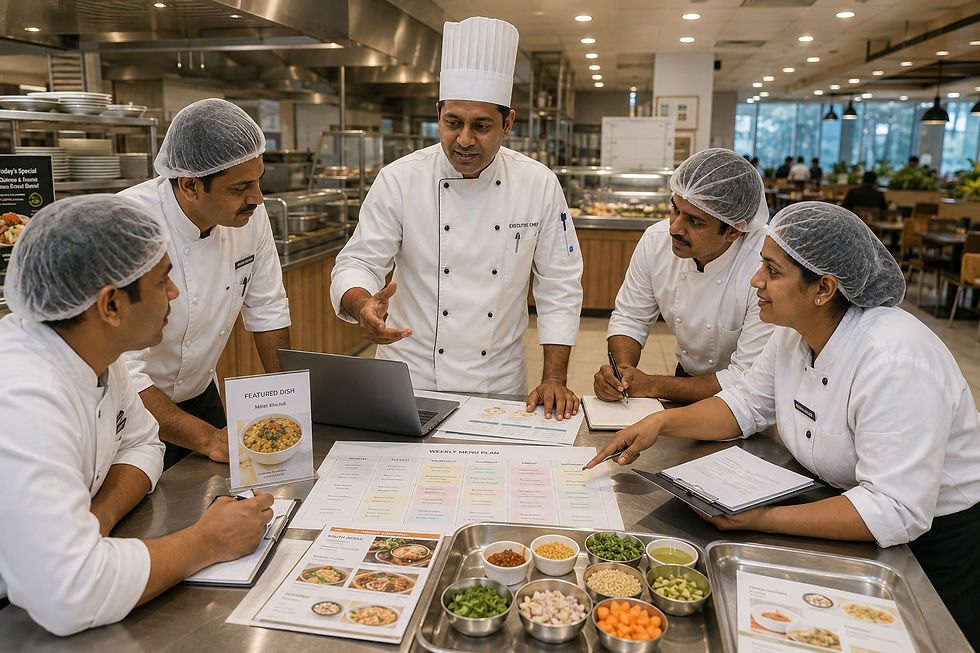
Most food waste in a corporate cafeteria is more of a planning failure than a service one - a fixed quantity per dish that doesn't move with the menu around it, or a safety buffer applied evenly across items that don't need it.
Many times, menu planning is done based on assumption rather than on real-time consumption patterns, which contributes to food wastage.
In one review across multiple corporate kitchens, SmartQ noticed that dal was planned at a flat 80g per pax regardless of what else was on the menu, even though actual consumption ranged from 65g to 85g depending on the accompaniment. A steady, low-demand side dish continued to be planned 20% above what people were actually eating, day after day.
These aren't edge cases. They're the default behavior of standard-portion planning, and they're exactly where the waste line comes from.
AI-based portion planning fixes this by replacing flat standards with predictions that account for the whole day's menu, not just the dish in isolation.
For instance, at one SmartQ corporate cafeteria, when Paneer Biryani was served alongside White Rice, predicted demand for White Rice dropped from 0.10 to 0.09 kg per pax, avoiding 8 kg of overproduction for 800 pax in that single meal. Swap the co-served dish and the same logic holds - Flavored Rice planned at 0.12 kg/pax alongside Veg Biryani needs only 0.115 kg/pax when Lemon Rice is on the menu instead, a small shift per pax that adds up fast at scale.
With the help of AI, SmartQ has launched data-driven consumption planning across their corporate cafeterias. And the impact is noteworthy!
Across SmartQ sites using this kind of predictive planning, food cost as a share of revenue has moved from roughly 55% to 52%, translating to real annual savings on a mid-sized site's buying volume, without any change to unit pricing or portion size at the plate.
This is the layer where menu planning stops being a kitchen habit and starts being a measurable input. Once portioning is driven by what a menu actually predicts people will eat (rather than a standard set once and left alone) the waste number that eventually lands in a BRSR disclosure is smaller. And, just as importantly, it is easier to defend when an assurance audit asks how it was derived.
How to Plan a Sustainable, BRSR-compliant Workplace F&B Program

Getting the cafeteria to contribute meaningfully to an ESG filing isn't a single initiative. It's a set of decisions that make the waste number a little smaller, and the audit trail a little cleaner.
Design the program around how your employees actually eat
A campus where most people arrive at 11 AM and leave by 7 PM doesn't need a heavy breakfast counter running from 8 AM. It needs a well-stocked mid-morning snack station and a lunch service that can absorb a crowd.
Where late nights are common but unpredictable, a vending machine with curated, fresh-adjacent options does more for employee satisfaction, and waste reduction, than a manned counter staffed on assumption.
The F&B program should be engineered around real attendance patterns and real consumption windows, not a one-size schedule inherited from a previous lease.
Menu curation should be driven by preference data, not intuition
Feedback doesn't have to be limited to a Google Form sent on Fridays. When ordering is digital, preference data accumulates naturally, what people choose and what they skip.
The menu that emerges from that data is what employees actually want, which means lower rejection rates, lower leftovers, and a better return on every rupee spent on ingredients.
Quantity planning is make or break for waste numbers
As we discussed earlier, the gap between what a kitchen plans and what employees eat isn't random. It's predictable if you're looking at the right inputs.
What else is on the menu that day? What day of the week is it? Is there a townhall running that will pull people away from the cafeteria at noon?
AI-based demand forecasting accounts for these variables and produces portion targets that move with the menu rather than sitting fixed regardless of context.
This is the layer that shows up in a BRSR disclosure as a materially different waste figure, and one that holds up when an assurance auditor asks how it was derived.
Surplus food needs a destination, not a trash can
Even with good planning, there will be surplus. Partnering with organizations like the Robin Hood Army gives that surplus a structured path, making it documented, recurring, and quantifiable. A consistent food redistribution program adds a second dimension to the sustainability story: not just waste reduced at source, but waste diverted from landfill and redirected to community use. Both are reportable. Both matter to an auditor and to an investor reading the filing.
Together, these aren't four separate programs. They're one coherent F&B operation built around data, and that's exactly what makes the numbers in a BRSR disclosure defensible rather than estimated.

Turning a Compliance Line into a Leadership Advantage
Institutions already investing in employee experience and sustainability don't need a new philosophy. What they need is the numbers under the philosophy to be real, current, and defensible when someone outside the company finally checks them.
The compliance requirement isn't going away, and neither is the opportunity sitting inside it. Getting ahead of both starts with treating corporate cafeteria management as what it's quietly become, i.e., a sustainability metric with a seat at the table.
SmartQ designs sustainable end-to-end workplace F&B programs through data-driven menu engineering, consumption planning and employee-first curation. Click here to get in touch or write to us at growth@thesmartq.com to understand what this could look like for your corporate cafeteria.
References:


Comments