


The ₹200 Meal Rule: Why India's 2026 Tax Update Could Change Corporate Cafeteria Management
- Paroma Bhattacharyya

- 14 minutes ago
- 7 min read

For over two decades, India's meal voucher exemption sat frozen at ₹50 a meal, a number so small it barely moved the needle on anyone's CTC. HR teams treated it as a compliance footnote, not a lever. Employees barely noticed it on their payslips.
That changed on April 1, 2026.
The Problem: A 4x Jump That Nobody's Systems Were Built For
Under the CBDT's (Central Board of Direct Taxes) Income-tax Rules, 2026, the tax-free meal voucher and meal-card limit was raised from ₹50 per meal to ₹200 per meal - a fourfold increase that pushes the annual tax-free ceiling from roughly ₹26,400 to over ₹1,05,000 per employee. Just as significantly, the update also removed the old restriction that had blocked this exemption under the new tax regime, so employees no longer have to be on the old regime to benefit.
This reform applies nationally. Every salaried employee in India benefits from the higher exemption, regardless of city or tax regime. Bangalore's workforce got a second reform on the very same date, though it's a separate matter entirely. Bengaluru, along with Pune, Hyderabad and Ahmedabad, was added to the 50% metro bracket for House Rent Allowance exemption, up from the 40% non-metro rate it had carried for years. That provision affects HRA, not meals, and only benefits employees still on the old tax regime.
Now, an employee anywhere in India has meaningfully more compensation that can legally sit outside their taxable salary, provided it's delivered through the right instrument. And that “provided” is where the real problem sits.
The exemption is not automatic. It only holds if:
The benefit is delivered as a card or voucher, never as cash. Cash meal reimbursements do not qualify for any exemption, no matter the amount.
It is spent only on food and non-alcoholic beverages, at eligible outlets (cafeterias, restaurants, food courts, canteens).
It is used strictly on working days, during working hours (weekends, leave days, and holidays don't count).
The employer can produce a clean, auditable transaction trail if the exemption is ever questioned.
When the ceiling was ₹50, getting this wrong cost an employee a few hundred rupees a year in avoidable tax, not worth building infrastructure around. At ₹200, getting it wrong on what is now close to a ₹1 lakh/year benefit, multiplied across an entire workforce, becomes a real payroll liability and a real point of employee frustration.
This is what turns a tax notification into a corporate cafeteria management problem: the money on the table is now large enough that how it's delivered, cash allowance, a generic voucher, or a properly instrumented cafeteria and card system, determines whether employees actually get to keep it.

What Exactly Changed: The Rules in Plain Terms
Here's the mechanism, stripped of jargon:
| Before April 2026 | From April 1 2026 |
Exemption limit | ₹50 per meal | ₹200 per meal |
Annual ceiling (2 meals/day, ~22 working days/month) | ~₹26,400 | ~₹1,05,600 |
New tax regime eligibility | Not available | Available |
Old tax regime eligibility | Available | Available |
Cash allowance | Never exempt | Still never exempt |
The legal basis remains the same framework that has always governed this benefit, Section 17(2) of the Income Tax Act, with the valuation mechanics set out in the Income-tax Rules, just recalibrated for 2026's food costs and extended to cover both tax regimes. Any employer-provided meal value that exceeds ₹200 for a single meal is taxed as a normal perquisite; only the portion within the cap escapes taxable salary.
For a two-meals-a-day office routine, that means an employee could receive up to ₹8,800 a month in fully tax-exempt meal value, a figure large enough that finance and HR teams reviewing compensation structures now have real incentive to route more of the CTC through this channel rather than as taxable cash allowance.
Why Cash Allowances Fall Short...And Why Food Cards Are a Smarter Allowance Benefit
It's worth dwelling on this, because it's the crux of the compliance problem: a cash food allowance, however generous, gets zero tax benefit. An employee receiving ₹8,800 a month as a straight cash "food allowance" line item pays full income tax on every rupee of it. The exact same ₹8,800, if paid through a compliant meal card or voucher instrument, is entirely tax-free.
This is the entire point of the reform. Which means the practical question for every company in 2026 isn't “should we offer a meal benefit”, most already do, it's “is our meal benefit structured in a way that actually captures the exemption, at scale, without creating an audit headache”. That question didn't have much urgency at ₹50 a meal. At ₹200, it does.

The Compliance Burden This Creates for Employers
Scaling a ₹200-per-meal exemption correctly across a workforce of a few hundred to several thousand employees is not trivial. Employers now need systems that can:
Restrict spend to eligible categories - food and non-alcoholic beverages only, automatically, without relying on employees to self-police.
Enforce time-of-use rules - purchases valid only during working hours on working days, which a physical voucher booklet has no way of enforcing.
Generate a digital audit trail - every transaction logged and attributable, so that if the exemption is ever scrutinized, the employer can produce records instantly rather than reconstructing them from paper chits.
Cap per-meal value at/ under the ₹200 line - not per day, not per month, but per meal that requires transaction-level granularity that a flat monthly allowance simply can't provide.
A generic gift-card-style meal voucher does very little to make the exemption effortless, visible, or scalable for either the employee or the payroll team. That is why the conversation is increasingly moving beyond “Which voucher provider should we use?” towards a more fundamental question: “How do we build an employee food benefit that can be managed, tracked and scaled effectively?”
A well-run digital cafeteria does all four by design - every purchase is already time-stamped, categorized as food, capped by menu pricing, and logged.
Why a Digitized Corporate Cafeteria Is the Natural, Compliant Channel for Food Allowances
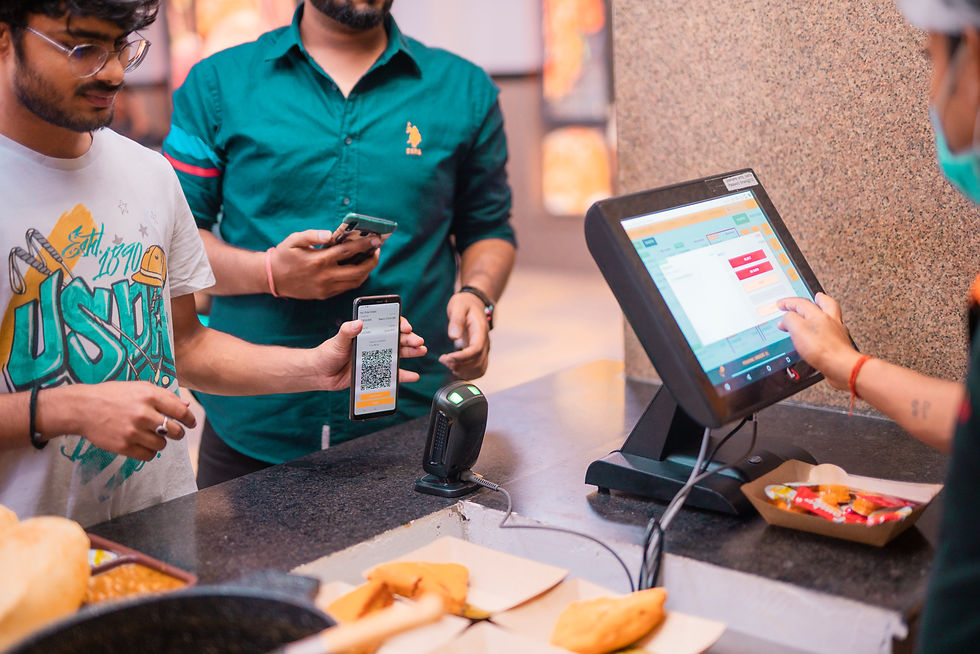
Put the pieces together and the workplace cafeteria turns out to be the cleanest way to deliver this benefit:
It's inherently time- and place-bound: Purchases happen on-site, during working hours, on working days, the exact conditions the exemption requires, with no extra enforcement needed.
It's inherently food-only: Unlike a general-purpose meal card that an employee might (deliberately or not) use for groceries or non-food items, a cafeteria's menu is, by definition, food and beverages.
It's inherently auditable: A digital cafeteria POS system logs every transaction against an employee ID, timestamp, and item, turning compliance from a manual reconciliation task into a reporting query.
It scales without per-employee friction: Employees need not remember spending rules; a robust system can enforce subsidies at the point of sale.
In other words, the ₹200 rule doesn't just make meal benefits more valuable. It makes the infrastructure behind those benefits more important. When the exemption was capped at ₹50 per meal, organizations were already dealing with taxable amounts whenever meal costs exceeded the limit. The difference now is that the value of the benefit being administered is significantly higher.
A subsidized cafeteria relying on manual registers and end-of-month reconciliation therefore carries greater financial and administrative risk: every missed transaction, incorrect subsidy or poorly maintained record can affect a much larger pool of employee benefits and create more work for HR and payroll teams.
Where Digital Cafeteria Management Platforms Come In

This is exactly the operational layer that companies like SmartQ have spent close to a decade building. SmartQ runs an end-to-end digital cafeteria suite for corporates and tech parks across India. Its platform covers digital ordering, cashless and queueless payment, vending and micro market integration, and critically, for this new tax landscape, transaction-level records that map cleanly onto the exemption's requirements: food-only, on working days, during working hours, per meal, per employee.
That combination matters more today than it did a year ago. Now, with four times the money at stake and eligibility extended to the new tax regime as well, the difference between a cafeteria that merely serves food and one that runs on a proper digital cafeteria management platform is the difference between an employee benefit that quietly works in the background and one that generates payroll disputes, under-claimed exemptions, or audit exposure.
For HR and finance teams re-evaluating their compensation structures this year, the practical shift is this: the choice is no longer just “cafeteria vs. meal card provider”. It's “which system gives us a defensible, automatic, per-transaction record of a food-only, working-hours-only benefit” - and a digital cafeteria operator built around exactly that discipline is now doing double duty as both an employee experience play and a tax compliance tool.
What HR and Finance Teams Should Actually Do

Audit current meal benefit structuring. If any portion of the meal component is still paid as cash allowance, it's leaving the entire exemption on the table, not a partial loss, a total one.
Move to card or cafeteria-based delivery for any meal component of CTC, since cash reimbursement has never qualified and still doesn't.
Check per-meal, not per-day, valuation. Systems built around a flat daily or monthly meal allowance may not map cleanly onto the ₹200-per-meal cap; transaction-level granularity matters now more than it used to.
Confirm new tax regime eligibility is reflected in payroll systems. Many payroll configurations built before April 2026 still assume the exemption only applies under the old regime.
Evaluate whether the existing cafeteria or food partner setup produces an audit-ready trail or whether it's still running on manual reconciliation that won't hold up if the exemption is questioned.
The Bottom Line
The ₹200 meal rule reads, on the surface, like a routine inflation-linked tax adjustment. In practice, by quadrupling the exemption and opening it to the new tax regime, it has turned the corporate cafeteria from a facility into a compliance-sensitive payroll instrument. It’s one large enough in value that how it's run now has real financial consequences for both employers and employees.
Companies which treat their cafeteria and meal-benefit infrastructure as an afterthought risk leaving real money on the table for their people. Those that invest in properly instrumented, digitally auditable cafeteria systems are positioned to turn a tax notification into a genuine, effortless employee benefit.
If your organization is rethinking how employee food benefits are managed, SmartQ can help evaluate if your cafeteria infrastructure is built for the value and compliance requirements.


Comments